Tuesday, July 5, 2011

Staycationing?

It's July.  Did you vacation in June or plan to go in August?  Or maybe you plan to stick close to home.  Chicago's Field Museum has a couple of tools that might make your staycation edutaining (educational and entertaining).

Rapid Color Guide: Plants
(http://fm2.fieldmuseum.org/plantguides/rcg_intro.asp?zone=tropical&guidetype=plant)
First, if you can only go as far as your computer screen, you'll want to take a look at the Rapid Color Guides.  From this page, you can link to downloadable, full-color guides to Tropical Plants in Central and South America.  Nature lovers will spend hours looking at the diversity of plants from this region.  Parents and educators will want to use the guides to help older students with science projects.  Even the youngest will enjoy looking at the shapes and colors that abound in these guides.  For them, maybe cutting up a couple of the guides and asking them to match shapes and/or colors would be a good way to spend a hot afternoon indoors this summer.  Describing the plants and discussing where they're from would be an edutaining bonus.

(http://fm2.fieldmuseum.org/plantguides/rcg_intro.asp?zone=tropical&guidetype=animal)
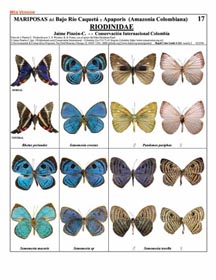
Next, I'd direct you to the Rapid Color Guides for Animals.  These guides break down the animal species found in tropical and subtropical locales.  An example of one of their butterfly guides appears on the left.  Anyone will enjoy exploring the rainforest or ocean via these colorful guides.  As with the plant guides, all guides are downloadable as well as searchable by country, subject, and taxonomic group.

And lastly, if you're in the Chicago area and would like to explore outdoors, you can check out the Field Museum's Keys to Nature Project (http://fm1.fieldmuseum.org/keystonature/). This online resource guides explorers through a series of questions to identify plants and animals in the Chicago area.  Looking it over, I think the resource would also work for a larger region around Chicagoland.  If you're in the Midwest, check it out and see if it works for you too.

If you have a Facebook account, the Rapid Color Guides--Field Museum has a page with links to all these resources and more.  You can find them here: http://www.facebook.com/RapidColorGuidesFieldMuseum?sk=info.

Wednesday, June 1, 2011

Look to the night skies

Summertime is almost here.  With school out, or about to be done for the summer, late night sky watching might be a perfect way to spend some time.  Of course it's cooler at night, so why not sleep a little longer in the morning and stay up late to locate planets and constellations.

My first suggestion is to get away from "light pollution," the reflection of city lights into the night sky.  Light pollution will limit the number of visible stars.  Our family likes to camp at least once overnight each summer to get away from light pollution and stargaze.  I recently downloaded Google's Sky Map app to my smartphone.  This free app uses GPS to plot the constellations in the sky based on my position.  It takes a little getting used to, but is a useful tool for identifying what exactly I'm looking at!

I also think it's important to prep before stargazing by either visiting a local planetarium or doing so virtually.  One of my favorite first stops is NASA's HubbleSite (http://hubblesite.org/explore_astronomy/tonights_sky/). From their Tonight's Sky location, you can view a monthly video that highlights the current night sky.  You can also link to sites that will help you build your own star chart to help identify what you're looking at.  The site also includes links to information about astronomy in general (black holes to cosmic collisions).  The menu bar across the top of the page includes a link to Education and Museums.  A quick click on the "Online Explorations" link redirects you to amazing games and other educational resources.  If you're only going to check one website before exploring the summer sky at night, this should be the one!

If you can't get away from light pollution, and there isn't a planetarium nearby, I recommend trying Stellarium. This downloadable, free, open-source program puts a 3-D planetarium on your computer.  According to their splash page:
It shows a realistic sky in 3D, just like what you see with the naked eye, binoculars or a telescope.
It is being used in planetarium projectors. Just set your coordinates and go.
Their splash page also includes screen shots so that you can see what the program offers.  I have not yet used this free resource, but know others who have and love it.  The images, they say, are like those projected at planetariums.  Stars and planets are identified.  It sounds like this would be a good resource for science teachers to use or for older students to use for projects.  Of course, amateur astronomers will appreciate it as well.

One last note about observing the night sky.  During a recent visit to the Cleveland Museum of Natural History, our "guide" in the planetarium announced a collaborative effort to open Observatory Park in Geauga County, Ohio.  The first of its kind, the park will offer dark sky opportunities for stargazing.  Details about this remarkable resource are available here: http://www.geaugaparkdistrict.org/documents/opfactsheet2011.pdf.  I think this may be my family's next camping trip for scanning the summer skies!  The park officially opens in August 2011 with some facilities available.  The park should be complete by January 2012.

Avoid summer's heat--explore the night sky!

Monday, May 2, 2011

Memorial Day is more than a long weekend...

If you're like me, you may want to put the meaning back in the long holiday weekend at the end of the school year.  According to an article in Time for Kids (http://www.timeforkids.com/TFK/kids/news/story/0,28277,1808979,00.html):
The holiday got started on May 30, 1868, when Union General John A. Logan declared the day an occasion to decorate the graves of Civil War soldiers. Twenty years later, the name was changed to Memorial Day. On May 11, 1950, Congress passed a resolution requesting that the President issue a proclamation calling on Americans to observe each Memorial Day as a day of prayer for permanent peace and designating a period on that day when the people of the United States might unite in prayer. President Richard M. Nixon declared Memorial Day a federal holiday in 1971. Memorial Day is now observed on the last Monday of May. It is an occasion to honor the men and women who died in all wars.
Perhaps the perfect place to discuss the significance of the holiday is at Arlington National Cemetery's official website (http://www.arlingtoncemetery.mil/).  Their photo album holds images of the solemn ceremonies and vast expanses of evenly spaced graves.  Also included are links with more information about the sites at Arlington, including the Tomb of the Unknowns.  But I think the richest resource they offer is on the Historical Information page.  Information about the history of the cemetery along with an expansive list of the famous politicians, explorers, minorities and presidents buried there is a capsule of American history. I get chills just writing about the Arlington National Cemetery.  If you haven't been there, this is the next best thing.  After a tour of their website, you'll get on the bandwagon to put the "memorial" back in Memorial Day.

Tuesday, April 5, 2011

Does anyone celebrate Arbor Day anymore?

My local elementary school fourth graders celebrate Arbor Day by entertaining the community garden club with a variety show all about trees followed by the ceremonial tree planting in memory of a garden club member.  Do any other communities do the same?  It's a wonderful tradition.

If you're interested in creating some Arbor Day festivities, maybe as a prelude to Earth Day, I've found some wonderful resources.  First, get everyone in the spirit by playing The Lorax's Save the Trees Game (http://www.seussville.com//games/lorax/).  Of course, as a librarian, I recommend reading Dr. Seuss's wonderful story as well.

Next, take a look at the youth activities available online at the Arbor Day Foundation (http://www.arborday.org/kids/).  You'll find online activities, printables, and contests to share with kids of all ages.  From the educators' link, you can access Arbor Day video and other resources.  This site alone could provide all the Arbor Day activities and lesson plan ideas you could want.

But wait!  There's more!  OPLIN (Ohio Public Library Information Network) has a terrific tool for anyone interested in trees: What Tree Is It? will identify trees by leaf, fruit or name.  A link gives background information about the anatomy of leaves or fruit.  Links also redirect visitors to the Ohio Department of Natural Resource's (ODNR) Division of Forestry website that is rich in information about trees in Ohio and includes education resources as well as Ohio Big Trees, another subsite of the ODNR.  Want to know how to measure a tree?  You can find that out at Ohio Big Trees.  As an Ohioan, I have access to this site; I hope you do as well.  If not, let me know and I'll see what other sites I can find in other states; or check your state's Department of Natural Resources or Forestry Department for information they may offer.

Now, get out there and hug, or plant, a tree! :)

Wednesday, March 2, 2011

A Broad View of Women's History

Since March is Women's History Month, I did a quick search for museum resources.  Of course, I went first to Library of Congress, and of course, they host a Women's History Month site (http://www.womenshistorymonth.gov/).  Well, that'd be a great resource, but maybe you all are getting tired of Library of Congress' input on just about everything....  LOC is still my go-to for information with a plethora of information on a wealth of subjects.

But...I found a new museum (well, new to me) that focuses entirely on women's history. The National Women's History Museum (http://www.nwhm.org) is, for now, a virtual museum dedicated to expanding "our knowledge of American history." Women's contributions to historical events were overlooked or censored for years. The National Women's History Museum (NWHM) "will serve to place women's history along side current historical exhibitions." According to their "About Us" page (the source of the above quotes, as well), "We have been a privately funded institution since our founding. Once a physical site is established, we will apply to the Smithsonian for an affiliation. This will enable us to borrow objects from the Smithsonian's collections for use in exhibitions."

Their online exhibits are immense and cover a range of ethnic, historic and entertaining moments in history. I think adding this resource to any American history or social studies lesson would facilitate discussions about who writes history and why, as well as providing another perspective on events. Since I discovered the The Smithsonian National Postal Museum's online exhibit entitled "The Black Experience: African-Americans on Stamps" in January, I looked at a similar exhibit on the NWHM's site.  "Leaving Their Stamp on History" highlights the stories of women who have appeared on United States postage stamps.  Along with an image of the individual stamps, a brief biography is listed in the online exhibit.  A link at the bottom of some stories navigates readers to more information about the person or pertinent events covered in other areas of the NWHM site.

I think you'll find this a resource you'll return to for many things beyond Women's History Month.